
FTSLED / Blog
Does 280 mW really give CRMX more range?
LumenRadio's Stardust advertises 280 mW, and Cerise tops out at 100 mW. That sounds like almost three times the range. It isn't, and the reason is a useful thing to understand about any wireless DMX system: how transmit power, antenna gain and the law fit together.
Short answer: the 280 mW comes mostly from the Stardust's antenna, not a much stronger radio. It buys about 1.7 times the range in open air, and it's only legal where the rules allow more than 100 mW. In the EU, the UK and Japan, every CRMX transmitter, the Stardust included, has to stay at or below 100 mW. Cerise can reach the same result with a larger 6 dBi antenna: check your local rules first, and ask us which antennas are compatible.
mW, dBm, dBi and EIRP
- mW (milliwatts) is the actual power a radio puts out.
- dBm is the same power on a logarithmic scale, relative to 1 mW: 20 dBm is 100 mW, 24.5 dBm is about 280 mW.
- dBi is antenna gain: how much an antenna concentrates power in some directions compared with an ideal antenna that radiates equally everywhere.
- EIRP (effective isotropic radiated power) is what actually leaves the antenna in its strongest direction:
EIRP = transmitter power (dBm) + antenna gain (dBi) − cable and connector losses (dB)
For example, a 20 dBm radio with a 3 dBi antenna and 1 dB of cable loss gives 22 dBm EIRP, about 158 mW.
| Power | dBm |
|---|---|
| 3 mW | 5 dBm |
| 13 mW | 11 dBm |
| 40 mW | 16 dBm |
| 100 mW | 20 dBm |
| 158 mW | 22 dBm |
| 280 mW | 24.5 dBm |
Two rules of thumb: every +3 dB doubles the power, and in open air every +6 dB doubles the range.
What 280 mW buys you
Going from 100 mW to 280 mW is +4.5 dB. In open air, that's about 1.7 times the range, not 2.8 times. On a real set, walls, bodies, trucks and other 2.4 GHz traffic matter more than that difference.
The Stardust has one more reason to transmit harder. In CRMX² mode it packs two universes into each radio channel, and Michael Karlsson, then R&D manager at LumenRadio, explained in LumenRadio's public user group that receivers lose about 2.5 dB of sensitivity in that mode. Making up 2.5 dB takes about 78% more power. Seen that way, the extra output is as much about keeping CRMX² range close to CRMX Classic as about going further.
How the Stardust reaches 280 mW
The figures come from the radio modules' FCC filings:
- TimoTwo, the CRMX module in Cerise and most CRMX gear: about 73 mW conducted (18.6 dBm), FCC ID XRSTIMOMWAN201.
- The module in the Stardust: about 90 mW conducted (19.5 dBm), FCC ID XRSTIMOMWAN301.
19.5 dBm plus a 5 dBi antenna is 24.5 dBm EIRP: the 280 mW. So the radio itself is only about 1 dB stronger than a TimoTwo; most of the difference is the antenna.
On paper, a TimoTwo with a 6 dBi antenna would land at about the same level, 24.6 dBm. In practice, don't fit just any antenna: a different antenna takes a certified transmitter outside its certification, and on Cerise, unsuitable antennas can damage the radios and void the warranty. If you need a higher-gain or a smaller antenna, contact us and we'll tell you which ones are compatible.
What Cerise transmits
Each Cerise radio can be set from 3 mW to 100 mW (5 to 20 dBm) with its supplied 2 dBi antennas, in the WebUI's Config tab: click a radio's "TX power" button and move the slider. With the supplied antennas, Cerise reaches 400 m and more in open line of sight.
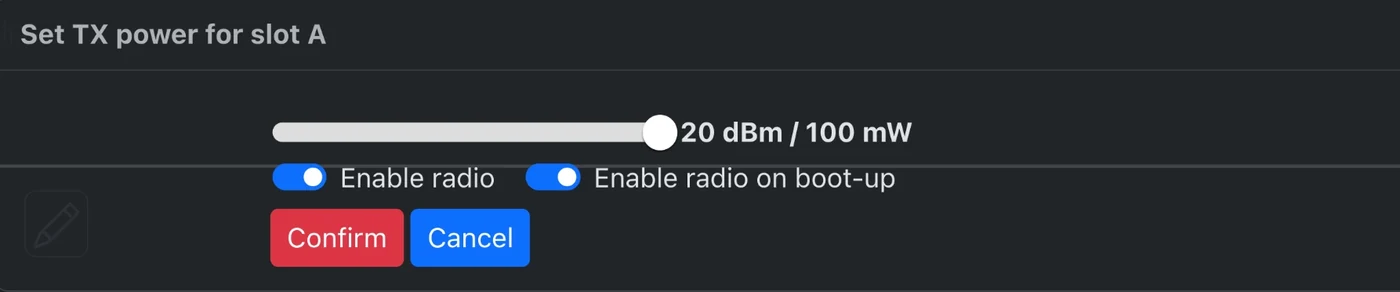
Full power isn't always best. On a small set or in a studio, a lower setting leaves more room for everyone else on 2.4 GHz, and your fixtures won't notice the difference.
Cramped spaces are a special case. In a bunker, a basement or an old building with thick walls, the signal bounces off every surface, and the reflections can cancel each other out at the receiver. Reception can then be poor even with the fixture a few metres away. Turning the power down or moving the transmitter slightly often helps more than turning it up.
The trade-off with high-gain antennas
Antenna gain doesn't create power; it moves it. A high-gain antenna sends more energy in some directions and less in others, like a spotlight compared with a floodlight. You get more reach where it points and less coverage everywhere else, so placement becomes more critical and fixtures that move around the antenna can drop out.
Move the slider to see how a vertical antenna's pattern changes with its gain. Seen from above, it stays a full circle; seen from the side, the "donut" gets flatter and reaches further along the horizon, and covers less above and below.
Where more than 100 mW is legal
The rules for 2.4 GHz differ by region:
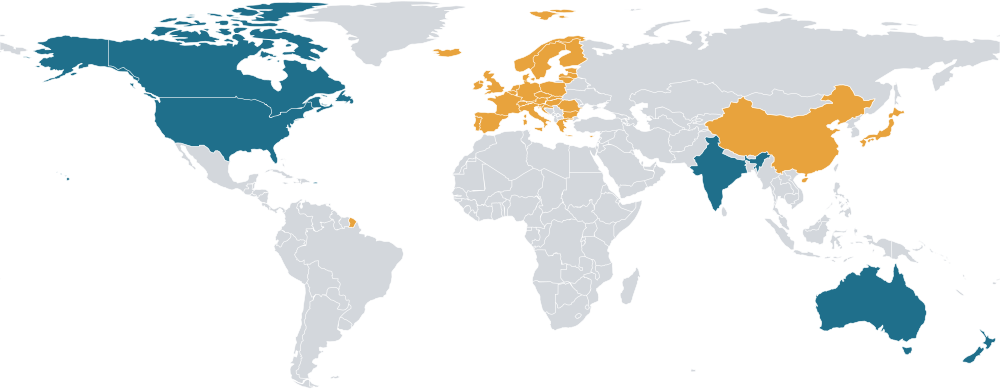
- EU and UK: 100 mW EIRP maximum, antenna gain included. A high-gain antenna means turning the transmitter down.
- United States and Canada: the limit applies to conducted power, with antenna gain counted separately, so transmitters can legally radiate well over 100 mW.
- Australia and New Zealand: also allow more than 100 mW for this kind of radio.
- India: up to 1 W from the transmitter and 4 W with the antenna's gain, without a licence.
- Japan, China and much of Asia: 100 mW or less.
Always check the current rules where you work: they change, some depend on indoor or outdoor use, and some countries require specific certification.
Better ways to get more range
Before reaching for more power:
- Get the antennas high and in line of sight of your fixtures.
- Keep the transmitter clear of metal, bodies and other transmitters.
- Block the channels other systems use with Cerise's spectrum analyzer, so CRMX isn't fighting for airtime.
- For long distances, relay the signal: a CRMX receiver feeding a second transmitter closer to the fixtures.
- If one output reaches less far than the others, check its antenna and connector with our troubleshooting guide.